
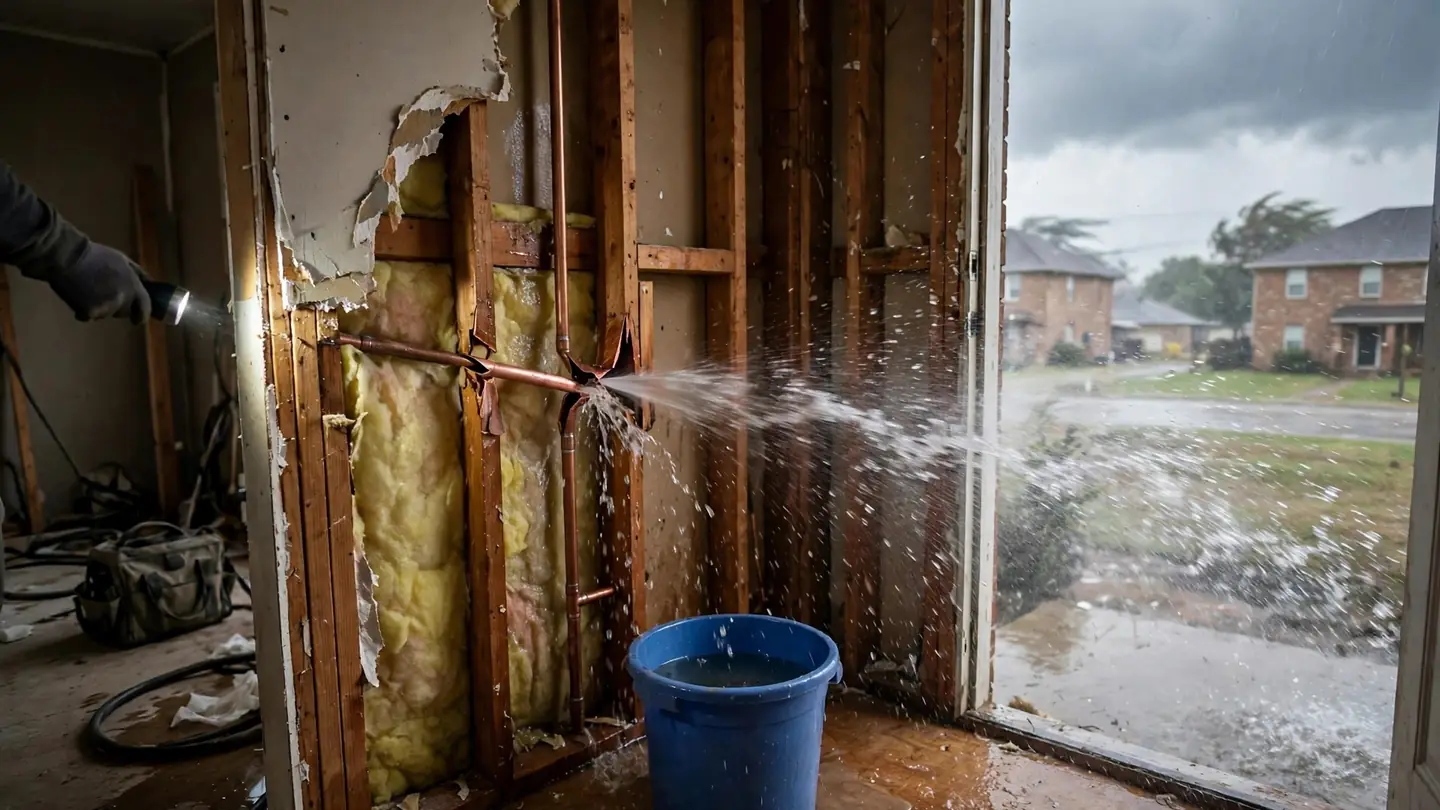
Key facts: Burst pipes
- During the February 2021 winter storm, burst pipes caused widespread water damage across Texas [1].
- Water from a burst supply line starts clean (Category 1) but can become contaminated if left standing [2].
- Drying wet materials within 24 to 48 hours helps prevent mold [3].
- Plumbing repairs in Texas are done by plumbers licensed by the Texas State Board of Plumbing Examiners [4].
Causes
Why pipes burst
Freezing is the cause most people think of. When water freezes it expands, and in a pipe that expansion pushes pressure toward the nearest closed valve. The split often happens not where the ice formed but in a stretch of pipe between the ice and a faucet. Pipes in exterior walls, attics, garages and crawlspaces are most exposed. North Texas does not freeze often, but when it does, as in February 2021, damage can be widespread [1].
Most bursts in Mansfield homes have nothing to do with ice. Rubber washing machine hoses split with age. Toilet and sink supply lines crack or their plastic nuts break. Fittings loosen. Older copper lines develop pinholes, and a pinhole under pressure can grow. Water pressure that runs too high, without a working pressure-reducing valve, stresses every connection in the house.
Warning signs
Signs of a burst or failing pipe
Sudden drop in pressure
A burst somewhere in the system can drop pressure at every fixture.
Sound of running water
Hissing or rushing in a wall or ceiling when nothing is on.
Fast-growing stain
A ceiling or wall stain that spreads in minutes rather than days.
Water meter spinning
With everything off, a moving meter dial means water is escaping.
Bulging drywall
Water building up behind drywall or in a ceiling can make it sag.
No water after a freeze
Frozen lines; the burst may only show when they thaw.
Response
What to do when a pipe bursts
Speed matters more than precision. Stop the water first, then deal with the details.
- 1
Shut off the main
Do not hunt for the exact pipe first. Close the main valve to stop all water.
- 2
Turn off power to wet areas
From a dry spot, switch off breakers for rooms where water is near outlets or fixtures.
- 3
Open a faucet
Opening a low faucet drains remaining pressure from the lines.
- 4
Protect and photograph
Move belongings, then photograph the break and the damage.
- 5
Call a plumber
The pipe needs repair before water can be turned back on.
- 6
Call for drying
A restoration contractor extracts water and dries the structure.
- 7
Notify your insurer
Sudden bursts are often handled differently from slow leaks. Ask how to report it.
Where it goes
Burst sources and where the water goes
| Burst point | Where the water usually goes |
|---|---|
| Attic line after a freeze | Through ceiling drywall into rooms below |
| Exterior wall line | Inside the wall cavity, then floor and carpet |
| Washing machine hose | Laundry floor, into adjoining rooms and the garage |
| Toilet supply line | Bathroom floor, hallway and the next room's carpet |
| Water heater connection | Garage floor and the shared wall with the house |
| Line under the slab | Up through flooring or into the soil under the house |
Drying
How a burst pipe loss is dried
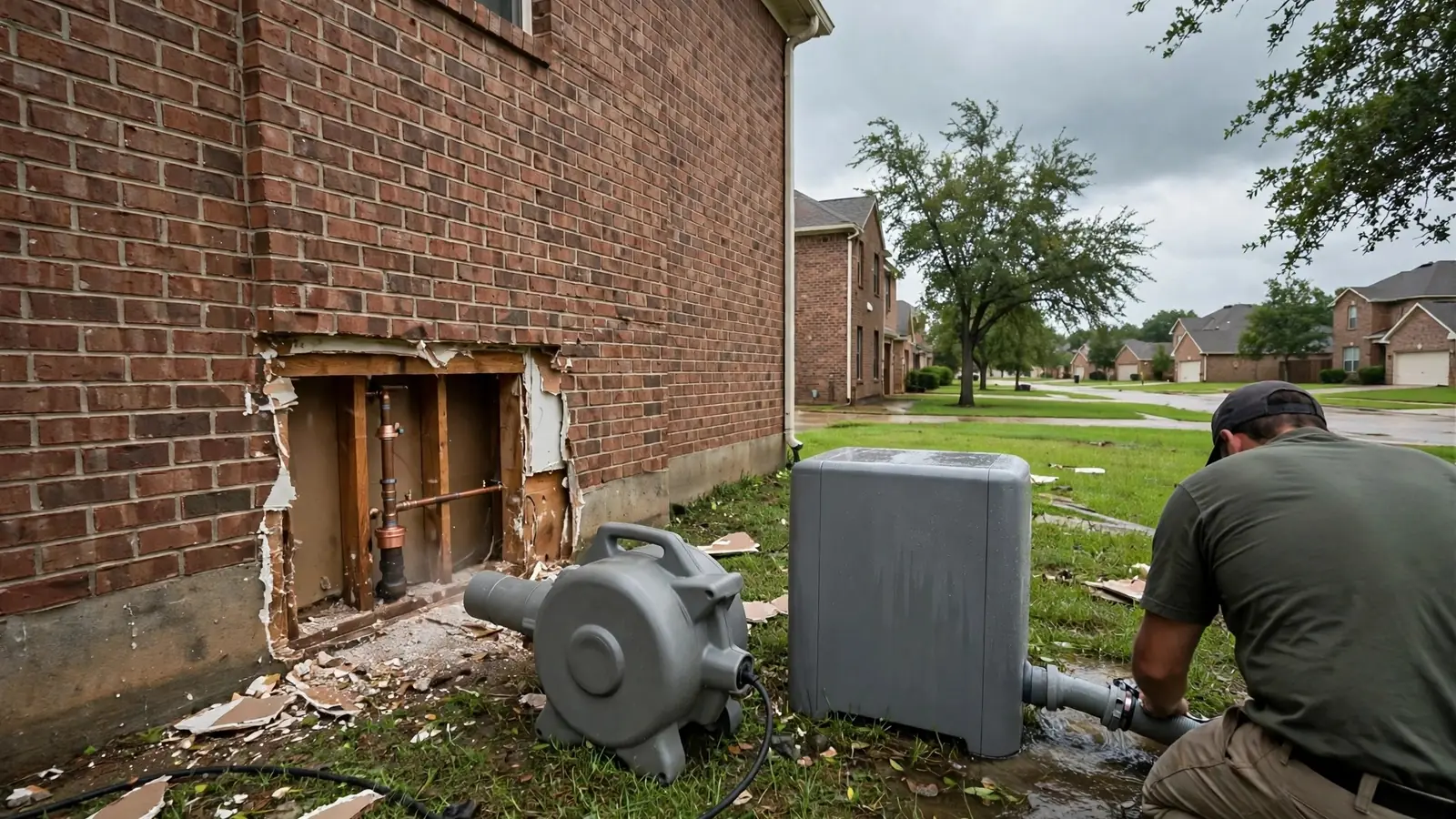
Because supply water starts clean, many materials can be dried rather than replaced if the work starts quickly. The contractor extracts water, removes pad and swollen baseboards, and dries walls and floors with air movers and dehumidifiers. Ceilings soaked from an attic burst usually lose their wet insulation and sometimes a section of drywall.
Readings decide when it is done. Moisture is measured each day and compared with unaffected materials elsewhere in the house, as the IICRC S500 approach sets out [2]. Most burst-pipe losses dry in several days.
If the water sat for days before it was found, for example while the house was empty during a freeze, it is treated more cautiously, and more materials may need removal.
The repair
Repairing the pipe itself
The plumber's job is to fix the break and check that nothing else nearby is about to fail. For a split in an accessible spot, that may be a short section of new pipe. For a line in a finished wall or ceiling, the plumber needs an opening, and it helps if that opening lines up with drywall the restoration contractor would remove anyway for drying.
Coordinating the two trades saves repairs later. Ask the plumber to note what failed and why, and keep the broken piece. If the cause was a defective part or a recent installation, that piece may matter to a warranty or insurance claim. After a freeze, ask the plumber to pressure-test the system, because one visible burst can hide a second crack elsewhere that has not leaked yet.
Prevention
Preventing the next burst
Replace rubber washer hoses and older plastic supply lines with braided stainless lines. Have a plumber check your water pressure; if it runs high, a pressure-reducing valve protects the whole system. Insulate pipes in the attic, garage and exterior walls.
Before a forecast freeze, let faucets on exterior walls drip, open cabinet doors so warm air reaches the pipes, cover outdoor faucets and disconnect hoses. If you travel in winter, leave the heat on and consider shutting off the main.
Leak sensors near the water heater, washer and sinks, especially combined with an automatic shut-off valve, turn many bursts into small puddles.
Local plumbing
Burst pipes in Mansfield homes
Most Mansfield houses keep plumbing in the slab, the walls and, in many homes, the attic, where the water heater or ice-maker line may run past the air handler. Attic lines are the ones most likely to freeze, and an attic burst sends water straight down through blown insulation into the ceiling. In the garage, the water heater supply and the washer connections are the usual weak points. Knowing which of these your house has tells you where to look first.
FAQ
Burst pipe questions
Will insurance cover a burst pipe?
Sudden, accidental bursts are often covered by homeowners policies, while long-term leaks may not be. Check your policy and ask your insurer.
Why did my pipe burst when it was not frozen?
Age, high water pressure, failed fittings and worn supply hoses all cause bursts without ice.
Can I turn the water back on after shutting the main?
Only after the burst section has been repaired or isolated.
Do I need to replace drywall after a burst pipe?
Not always. Clean water caught early can often be dried. Ceilings with wet insulation more often need repair.
How long does drying take?
Often several days. Readings show when it is complete.
Can I call if a pipe bursts in the middle of the night?
Yes. Freezes and bursts often happen overnight, and calls are answered 24/7.